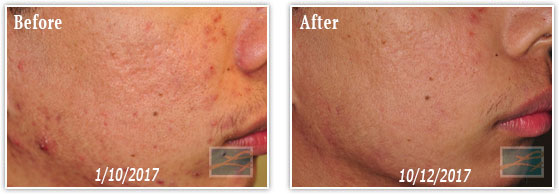
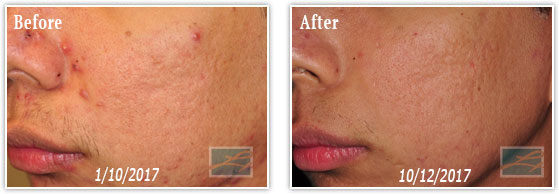
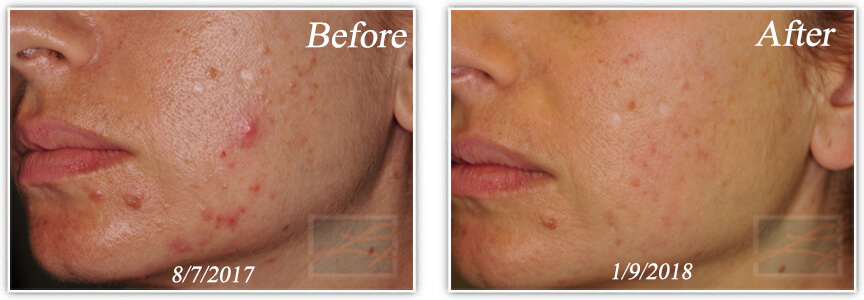
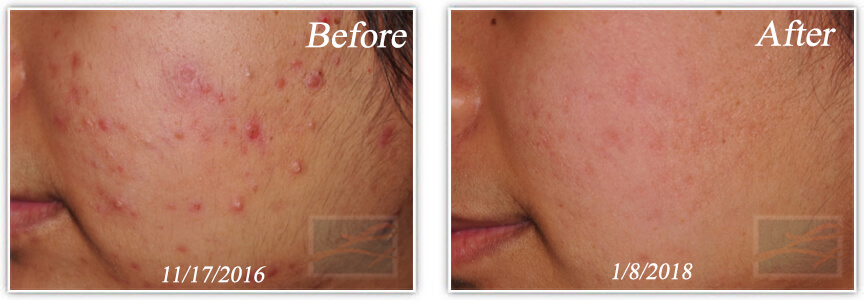
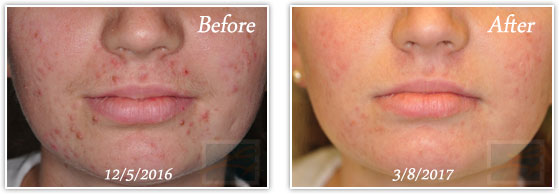
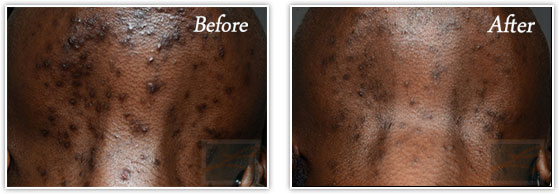
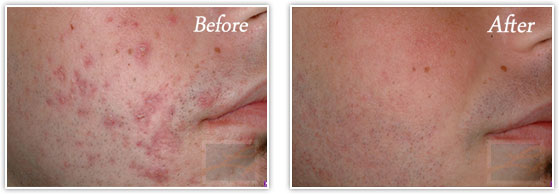
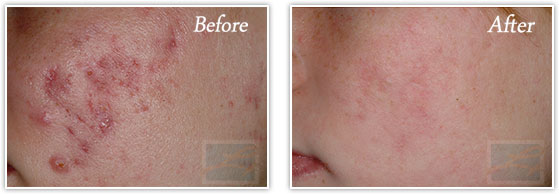
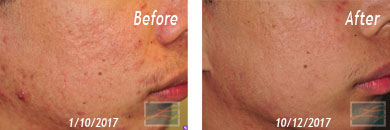
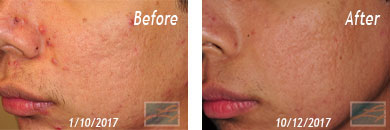
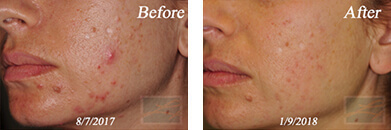
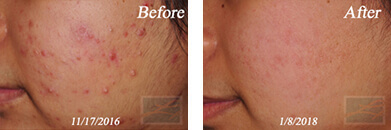
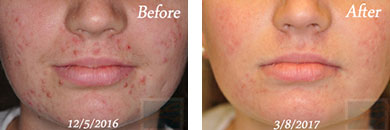
Acne is an inflammatory, relapsing skin condition that appears when the pilosebaceous opening (the pore) becomes impacted with dead skin cells. Sebaceous glands produce oil intended to keep hair and skin lubricated and waterproof. When that sebum combines with dead skin cells, environmental debris and certain cosmetics, pores become blocked and bacteria will thrive. The plugged pores become swollen and inflamed, and sometimes fill with infection. If the pore is ruptured in the process (or from picking and squeezing), discoloration and scarring can occur.
These breakouts go by many names – whiteheads, blackheads, pimples, pustules, nodules, cysts, and comedones – depending on their locations and characteristics. However, if you’re one of the 17 million Americans with acne, you probably aren’t as concerned with the name as you are with clearing your skin.
Acne isn’t just an adolescent ailment or specific to women. Males and females of any age can have acne. It commonly occurs on the face, neck, back, buttocks and chest. Friction can result in worsening of the acne.
While medical science continues to learn more about the precise causes of acne, we know that it is often triggered by hormonal changes. Puberty, menstrual cycles, birth control pills, pregnancy, menopause, and stress are common reasons for acne flare-ups. There is increasing evidence that certain foods (especially those with a high glycemic index) can exacerbate acne. There is often a family history in those with severe or early-onset acne.
Acne isn’t generally a threat to your physical health, but it carries a big emotional burden. Here at the
Lupo Center, we guide our patients in a three-step program to eliminate it:
- Heal current acne. After a thorough skin analysis and consultation to understand your medical situation and lifestyle, our doctors customize a treatment program to eliminate existing acne lesions. They may begin with an individualized combination of topical treatments (benzoyl peroxide, salicylic acid or retinol) and oral medications (antibiotics, Accutane®, low-dose contraceptives). Additional state-of-the-art techniques such as chemical peels, dermal infusion, resurfacing, and laser therapy efficiently alleviate even severe breakouts.
- Prevent future acne. An at-home regimen with high-quality products for your specific skin type keeps your complexion soft, refines pores, and minimizes future acne flare-ups.
- Prevent and remediate scars. Professional treatment and excellent home care products greatly reduce the risk of scarring. However, our doctors have a number of minimally invasive revision techniques for patients with acne damage.
You don’t have to suffer from acne or risk a lifetime reminder of an acne-prone period in your life. Talk with our doctors about modern treatment options.
Don’t Pick Acne
It can be tempting to pick acne! Dr. Lupo helps you understand acne and how blemishes form, in an attempt to help you visualize how the blemishes and scars are formed because of picking acne.
So everyone knows that dermatologists are always nagging our patients not to pick. And that seems sort of mean because when you got a big old pimple there it is only natural to want to squeeze it, get that stuff out and maybe have it heal quicker. But that couldn’t be further from the truth. In fact, when you squeeze a pimple you make it worse. But let me explain to you why. I am a big believer that if you can visualize something and understand it you are going to be more likely to be more compliant with the doctor’s recommendation. So think about your skin as the surface of a pore as an opening. And there’s a shaft which is the pore itself that goes down deeper into the skin, past the epidermis into the dermis of the skin. Then envision that there’s an offshoot of that shaft and there’s a smaller shaft with an oil gland or sebaceous gland at the end of that. So what normally happens in the skin is the sebaceous gland produces the oil which goes out of the sebaceous duct, into the pore duct and then it is extruded to the surface of the skin. Unfortunately, when you have the acne, the skin cells that line that shaft are not behaving properly and they start to clump. This is called diskeratinization. And this is why retinoids are so important because retinoids help with the process of keratin or dead skin cells extruding from the pores. So when those dead skin cells build up, so does the oil. Now, if you squeeze that blemish, you can actually fracture that shaft and the reason that is bad is all of that oil and all of the dead skin cells which is supposed to be in the pore, in that shaft actually get extruded into the dermis of the skin. This causes a foreign body reaction. This means there is an influx of white blood cells, an influx of inflammatory mediators and you get a nodule underneath the skin that can trigger scar tissue. In addition, there is pigment in the skin cells that gets disrupted and it goes deeper into the skin. Deeper pigment in the dermis is darker from the surface. It is called the tyndall effect. And this is why dark spots that you get from squeezing acne blemishes last for a long long time. Because the pigment is in the wrong place. So now if you know why it is so bad to squeeze those pimples, maybe you won’t do it.
CLn Face Cleansers for Acne
Dr. Lupo explains the different face cleansers that are available from CLn to help address your acne issues.
Today I am going to talk to you about two of my favorite over-the-counter products. One is the CLn facial cleanser. This cleanser is particularly good if you are on an acne treatment program that makes your skin a little dry. If you just want one product to use for mild acne, you can use the CLn acne cleanser which is gentle but has 1 per cent salicyclic acid to help unclog your pores.
Tailored Acne Treatments for Females
Dr. Lupo explains four different acne treatment options available to females. She also discusses the effects of diet and hormones on acne and how these can be addressed.
Today I thought we would discuss the initial consult for a female with acne. A lot of people find going to a physician somewhat initimidating so I would like to walk you through a typical acne consult with me. As a board certified dermatologist and I do have training in internal medicine I think it is important for me to get an idea of the patient’s entire medical history. I also like to review diet because there is an influence with your diet that is very high in sugar worsening your acne. But I usually explain to my female patients, that there are really four distinct tracks of treatment that we can put them on. The most well known, I call conventional therapy. Now, conventional therapy includes things like topical retinoids, topical antibiotics and it includes oral antibiotics and sometimes sub-antimicrobial agents that act as anti-inflammatories. What we do initially is start almost everyone on some combination in conventional therapy. Now there are people that cannot take antibiotics. You may know that acne is often a co-problem with ulcerative colitis. People with colitis really shouldn’t take a lot of oral antibiotics. But we get all of that information and we will start you on a program, typically topicals for sure, retinoids almost always and then a combination of either oral or topical antibiotics. Now, we usually like patients to give us at least six weeks before they see any real improvement. I have been involved in clinical trials and in all the clinical trials that I have been involved with for acne, the end point is 12 weeks. But the truth of the matter is that usually by six weeks we are seeing some improvement. I think it is of utmost importance to adjust the medication if you are not seeing significant improvement after 12 weeks. Now the second track for women is a thorough investigation as to their hormonal history. There is something call hormonal acne and for patients who have hormonal acne, we will often use a combination of topical medicines with the retinoids but we will add either oral contraceptives and/or a drug called Spironolactone. Spironolactone is a very very interesting medication. It is used quite a bit in acne treatment and also in all of dermatology. Because it is an anti-androgen which we can safely use in females who are not planning to get pregnant. This is why we often combine it with the oral contraceptive. But it actually blocks the action of androgens at the oil gland and improves acne that way. We will also ask questions about your menstrual cycle – is it normal and do you typically get a flare at a particular time of your month. Now the third track is the use of Isotretinoin, also known commonly as Accutane. Accutane is a retinoid and it is teratogenic which means it can cause birth defects. So it is only used in women of child bearing age who are on two forms of birth control pills and another form of oral contraceptive or physical barrier or something like that. But it has to be two forms of birth control. Now there is a registry to verify that you have been educated by your physicians as to the risks and you are going to comply with the requirements. Now Accutane is usually used in people with very very severe acne. Acne that is scarring and acne that has not responded to either option 1 or option 2. Now the fourth and final option is what I call the device option. We at the Lupo Center have a number of devices that have been shown in clinical study to improve acne and usually the mechanism by which these devices work is that the heat shrinks the sebaceous gland. Now the problem with devices is that they are not covered by insurance but they do offer an alternative for patients who do not want to use any type of medication in their system and who also happen to have an element of acne scarring. Because these devices while they are improving your acne, they are improving your acne scarring. And we also in the device category sometimes use certain types of peels. Most effective ones for acne are typically Salicylic and Mandelic peels. So what I think I want you to know in that first acne consultation is to feel that all your options have been explained to you, you know the pluses and minuses of each and you have had an opportunity to ask questions and that you and I, together, can make the best choice for you.
How stress can damage your aesthetics
Dr. Lupo helps you undesrtand how stress can affect your overall aesthetics. She discusses the different skin conditions that can be triggered by stress and talks about how you can ensure that stress doesn't get ahead of your health.
Hi everyone, it is November 2020 and I think we can safely say that this has been a pretty stressful year. And it doesn’t look like this stress is going to go away. So let’s talk about stress effects on our skin. We all know that stress is bad for everything but let’s talk specifically about our skin. When you are under stress, your resistance is down. That is actually why fever blisters, also known as herpes simplex will often come out when you are physically or emotionally stressed. Another problem dermatologists see is telogen effluvium. Telogen effluvium is the shedding of the hair, in response to stress. That occurs when the normal growing cycles of the hair follicles all go into telogen or shedding phase at the same time. The good news is telogen effluvium can usually be improved with the use of nutrafol. Now, we all know that stress causes acne breakouts. So lot of people are talking about masking, which is acne for masks but really and truly guys, it is from the stress. So the reason for that is that stress has a direct effect on cortisol, increasing it, which has a direct effect on our oil glands to increase the oil output. The greater the oil output, the greater the chance that that pore will get clogged and you will get a blemish. Always remember no matter how bad that blemish looks, please don’t pick it because it actually increases your chances of scarring. A lot of people don’t know that seborrheic dermatitis, which is a flaky condition in the scalp, sometimes called dandruff, but it can also affect between the eyebrows, in the ears and in other parts of the body. Well seborrheic dermatitis, also exacerbated stress, in addition, atopic dermatitis and psoriasis are two chronic conditions of the skin with itchy, flaky patches and plaques that will also be worsened by stress. So I know you can’t control the stress, but try to control the stress’ effect on your system. Do thinks like regular exercise, make sure you are getting enough sleep, talk to friends, talk to therapists, try to do deep breathing techniques, meditate, do whatever you can do to help you manage your stress. It is worthless to be upset about something that you directly can’t control so don’t let stress make you get more stressed because your skin breaks out.
Lupo Center for Aesthetic and General Dermatology
Mary P. Lupo, M.D. - Connect on Linkedin
Our mission at the Lupo Center is to provide patients with innovative, effective and ethical care to make each person look and feel their personal best. To fulfill our goal, we provide state-of-the-art medical, surgical and cosmetic treatments to all patients.
Board certified dermatologist and clinical professor of dermatology Mary P. Lupo, MD has been a leader in the field of non-surgical rejuvenation since 1983. She travels internationally to teach her innovative techniques, and her reputation brings in patients from around the country. She started the first formal residency training program for injectables and peels in 1983 at Tulane Medical School and served as past president of Women’s Dermatologic Society, adjunct professor of dermatology at Tulane and a founder of Cosmetic Boot Camp. Dr. Lupo holds membership in many prestigious dermatology associations, participates in clinical trials for approval of new drugs and devices and acts as an advisor for numerous aesthetic-minded companies.